Evidence base, scope, and assumptions
This guide combines two kinds of inputs: (a) Kohzar label data extracted from the product label artworks you provided (Date Syrup 500 ml, Gur/Sugarcane Syrup 500 ml, Honey 700 g, Stevia Syrup 500 ml), and (b) reference nutrition science for seeds, nuts, and dried fruits (and a few closely related items you may add later). For nutrition science and health effects, the emphasis is on primary/official sources and peer‑reviewed systematic reviews, including guidance from the World Health Organization, the Food and Agriculture Organization of the United Nations, and high‑quality evidence syntheses (systematic reviews/meta‑analyses and major clinical trials)
Evidence base, scope, and assumptions
To keep “benefits” and “condition effects” honest and non-overclaiming, each condition is labeled:
- Strong: consistent findings from multiple randomized trials and/or authoritative guidelines.
- Moderate: some trial evidence and/or consistent observational evidence, but with limitations (small samples, heterogeneity, shorter duration).
- Limited: preclinical/animal data, mechanistic plausibility, small or inconsistent human evidence, or evidence not specific to the product form/dose (e.g., whole dates vs. date syrup).
“Free sugars” context (important for syrups and honey)
The WHO guideline on sugars emphasizes reducing free sugars across the life course; it defines free sugars to include sugars naturally present in honey and syrups, and recommends keeping free sugars below 10% of total energy (strong recommendation) with a suggested further reduction below 5% for additional benefit (conditional).
This matters because date syrup, sugarcane syrup (gur/jaggery syrup), and honey are all “free sugars” in WHO’s framework even when “natural” or “unrefined.”
Assumptions and “unspecified” flags
- For Kohzar sweeteners, ingredient and nutrition values are treated as label-specified.
- For seeds, nuts, and dried fruits, USDA FoodData Central is used primarily as the reference backbone. Actual values can vary by cultivar, origin, drying method, and whether products are salted, roasted, or otherwise processed.
- Items like “Charmagz/Chaar Maghaz”, “Mixed nuts”, and “Mixed dry fruits” are inherently variable; they are treated as composition-dependent and marked accordingly.
Sweeteners: book-ready product chapters
Kohzar Natural Date Syrup
-
Executive summary. Kohzar Date Syrup is a single‑ingredient sweetener (100% dates, concentrated) with measurable potassium, magnesium, and iron per label—yet, nutritionally it behaves primarily as a concentrated free-sugar source, so the main “health lever” is portion size and where it replaces other sugars rather than unlimited use. WHO guidance supports limiting syrups as free sugars even when “natural.”
Product description. A pourable syrup made by concentrating whole dates; positioned as an alternative to refined sugar for tea/coffee, desserts, cooking/baking, yogurt/oats, and cold drinks (per label artwork).
Ingredients
Nutrition facts (Kohzar label-derived): per serving and per 100 g.
Serving size on label: 20 g.
| Nutrient |
Per 20 g (label) |
Per 100 g (calculated from label) |
| Energy |
≈ 55–60 kcal |
≈ 275–300 kcal |
| Carbohydrates |
≈ 14–15 g |
≈ 70–75 g |
| Sugars |
≈ 12–14 g |
≈ 60–70 g |
| Protein |
0 g |
0 g |
| Fat |
0 g |
0 g |
| Sodium |
≈ 2–5 mg |
≈ 10–25 mg |
| Calcium |
≈ 8–15 mg |
≈ 40–75 mg |
| Iron |
≈ 0.4–0.8 mg |
≈ 2.0–4.0 mg |
| Magnesium |
≈ 15–25 mg |
≈ 75–125 mg |
| Potassium |
≈ 220–280 mg |
≈ 1,100–1,400 mg |
Macro/micronutrient breakdown (interpretation).
- Macros: essentially carbohydrate/sugar calories (like most syrups). In diets targeting glycemic control or weight management, the dominant consideration is the sugar load per tablespoon (WHO “free sugars” framing).
- Micronutrients: potassium and magnesium are meaningful relative to many refined sugars (which contain negligible minerals), but micronutrients do not negate free‑sugar limits at typical health‑focused serving sizes.
Evidence-based benefits mapped to population groups and life stages (what is realistic).
- Adults (men and women): best framed as a flavor/functional sweetener with some minerals, useful when it replaces higher‑added‑sugar choices; not a “therapeutic” product. WHO sugar guidance applies equally to adults across sexes.
- Children/adolescents: can be used in small amounts, but children are also covered by WHO free-sugar recommendations; practical focus is dental caries and total dietary sugar.
- Older adults: may be useful as a palatable energy source in low appetite, but portion control is still key; consider potassium load in advanced kidney disease (general potassium restriction guidance is individualized).
- Pregnancy/lactation: date products are common foods; no special benefit claims should be made. Use within general free‑sugar limits.
Recommended use cases and timing (practical guidance).
- Best use: replace refined sugar in beverages or recipes without increasing total sweetness.
- Serving guidance: use 1 tbsp (~20 g) as a reference upper single-use portion (matches label). If using multiple times per day, track total “free sugars.”
- Timing ideas:
- Pre‑activity quick energy (e.g., before a walk/workout) if sugar fits the person’s plan.
- Post‑meal dessert substitute in small amounts instead of candy/sweetened drinks.
Contraindications, allergies, and interactions.
- Diabetes/prediabetes: not contraindicated as a food, but likely raises blood glucose; incorporate with carbohydrate awareness. Evidence from a randomized trial in type 2 diabetes found no glycemic harm from daily dates (whole fruit) over 12 weeks, but that evidence does not automatically transfer to syrups (more concentrated, lower fiber). Treat effect as “sugar-like” unless proven otherwise for the syrup form.
- Kidney disease with potassium restriction: date syrup can be potassium‑dense per label; whether it matters depends on the individual plan and total potassium.
Likely effects for common conditions (with evidence strength).
| Condition |
Likely effect |
Evidence strength |
Why |
| Diabetes / glycemic control |
May raise glucose like other syrups; use small portions |
Strong (sugar limits) |
WHO treats syrups as free sugars; sugar reduction lowers NCD/dental caries risk. |
| Weight management |
Calorie-dense; may hinder deficit if overused |
Strong (sugar limits) |
Free-sugar reduction is core; sweeteners “health halo” can drive overconsumption. |
| Cardiovascular health |
Neutral-to-negative if it increases total sugar; neutral if it replaces refined sugar without increasing total |
Moderate |
Excess free sugar links to cardiometabolic risk; replacement without excess can be neutral. |
| Digestion |
Minimal fiber in syrup; whole dates are different |
Limited (for syrup) |
Most GI benefits of dates are tied to fiber/whole fruit matrix. |
| Immunity / “antioxidants” |
Contains naturally occurring polyphenols, but clinical impact at serving sizes is unclear |
Limited |
Polyphenols exist in dates, but clinical outcomes depend on dose and diet context. |
| Pregnancy/lactation |
Food use acceptable; avoid benefit claims |
Limited |
No guideline-supported therapeutic claim for date syrup. |
Recipes / usage tips.
- Date latte: 1 tbsp date syrup + milk + espresso + cinnamon.
- Yogurt bowl: 1–2 tsp date syrup + plain yogurt + walnuts + chia seeds (balances sweetness with fat/fiber).
- Marinade/glaze: date syrup + lemon + salt + chili + garlic for roasted carrots or chicken.
Storage and shelf-life (Kohzar label).
- Store in a cool, dry place; refrigerate after opening; use within ~3 months; natural thickening/separation may occur; warm gently in warm water if needed (per label).
Kohzar Natural Sugarcane Syrup (Gur Syrup)
-
Executive summary. Kohzar Date Syrup is a single-ingredient sweetener (100% dates, concentrated) with measurable potassium, magnesium, and iron per label—yet, nutritionally it behaves primarily as a concentrated free-sugar source, so the main “health lever” is portion size and where it replaces other sugars rather than unlimited use. WHO guidance supports limiting syrups as free sugars even when “natural.”
Product description. A pourable syrup made by concentrating whole dates; positioned as an alternative to refined sugar for tea/coffee, desserts, cooking/baking, yogurt/oats, and cold drinks (per label artwork).
Ingredients
Nutrition facts (Kohzar label-derived): per serving and per 100 g.
Serving size on label: 20 g.
| Nutrient |
Per 20 g (label) |
Per 100 g (calculated from label) |
| Energy |
≈ 55–60 kcal |
≈ 275–300 kcal |
| Carbohydrates |
≈ 14–15 g |
≈ 70–75 g |
| Sugars |
≈ 12–14 g |
≈ 60–70 g |
| Protein |
0 g |
0 g |
| Fat |
0 g |
0 g |
| Sodium |
≈ 2–5 mg |
≈ 10–25 mg |
| Calcium |
≈ 8–15 mg |
≈ 40–75 mg |
| Iron |
≈ 0.4–0.8 mg |
≈ 2.0–4.0 mg |
| Magnesium |
≈ 15–25 mg |
≈ 75–125 mg |
| Potassium |
≈ 220–280 mg |
≈ 1,100–1,400 mg |
Macro/micronutrient breakdown (interpretation).
- Macros: essentially carbohydrate/sugar calories (like most syrups). In diets targeting glycemic control or weight management, the dominant consideration is the sugar load per tablespoon (WHO “free sugars” framing).
- Micronutrients: potassium and magnesium are meaningful relative to many refined sugars (which contain negligible minerals), but micronutrients do not negate free-sugar limits at typical health-focused serving sizes.
Evidence-based benefits mapped to population groups and life stages (what is realistic).
- Adults (men and women): best framed as a flavor/functional sweetener with some minerals, useful when it replaces higher-added-sugar choices; not a “therapeutic” product. WHO sugar guidance applies equally to adults across sexes.
- Children/adolescents: can be used in small amounts, but children are also covered by WHO free-sugar recommendations; practical focus is dental caries and total dietary sugar.
- Older adults: may be useful as a palatable energy source in low appetite, but portion control is still key; consider potassium load in advanced kidney disease (general potassium restriction guidance is individualized).
- Pregnancy/lactation: date products are common foods; no special benefit claims should be made. Use within general free-sugar limits.
Recommended use cases and timing (practical guidance).
- Best use: replace refined sugar in beverages or recipes without increasing total sweetness.
- Serving guidance: use 1 tbsp (~20 g) as a reference upper single-use portion (matches label). If using multiple times per day, track total “free sugars.”
- Timing ideas:
- Pre-activity quick energy (e.g., before a walk/workout) if sugar fits the person’s plan.
- Post-meal dessert substitute in small amounts instead of candy/sweetened drinks.
Contraindications, allergies, and interactions.
- Diabetes/prediabetes: not contraindicated as a food, but likely raises blood glucose; incorporate with carbohydrate awareness. Evidence from a randomized trial in type 2 diabetes found no glycemic harm from daily dates (whole fruit) over 12 weeks, but that evidence does not automatically transfer to syrups (more concentrated, lower fiber). Treat effect as “sugar-like” unless proven otherwise for the syrup form.
- Kidney disease with potassium restriction: date syrup can be potassium-dense per label; whether it matters depends on the individual plan and total potassium.
Likely effects for common conditions (with evidence strength).
| Condition |
Likely effect |
Evidence strength |
Why |
| Diabetes / glycemic control |
May raise glucose like other syrups; use small portions |
Strong (sugar limits) |
WHO treats syrups as free sugars; sugar reduction lowers NCD/dental caries risk. |
| Weight management |
Calorie-dense; may hinder deficit if overused |
Strong (sugar limits) |
Free-sugar reduction is core; sweeteners “health halo” can drive overconsumption. |
| Cardiovascular health |
Neutral-to-negative if it increases total sugar; neutral if it replaces refined sugar without increasing total |
Moderate |
Excess free sugar links to cardiometabolic risk; replacement without excess can be neutral. |
| Digestion |
Minimal fiber in syrup; whole dates are different |
Limited (for syrup) |
Most GI benefits of dates are tied to fiber/whole fruit matrix. |
| Immunity / “antioxidants” |
Contains naturally occurring polyphenols, but clinical impact at serving sizes is unclear |
Limited |
Polyphenols exist in dates, but clinical outcomes depend on dose and diet context. |
| Pregnancy/lactation |
Food use acceptable; avoid benefit claims |
Limited |
No guideline-supported therapeutic claim for date syrup. |
Recipes / usage tips.
- Date latte: 1 tbsp date syrup + milk + espresso + cinnamon.
- Yogurt bowl: 1–2 tsp date syrup + plain yogurt + walnuts + chia seeds (balances sweetness with fat/fiber).
- Marinade/glaze: date syrup + lemon + salt + chili + garlic for roasted carrots or chicken.
Storage and shelf-life (Kohzar label).
- Store in a cool, dry place; refrigerate after opening; use within ~3 months; natural thickening/separation may occur; warm gently in warm water if needed (per label).
Kohzar Natural & Pure Honey
Executive summary. Honey is nutritionally a sugar-rich food (free sugars per WHO), but it has a uniquely evidence-supported role for symptomatic cough relief in people over 1 year old, where high-quality reviews show benefit vs placebo/no treatment for short-term cough symptoms. It must never be given to infants under 12 months due to botulism risk.
Product description. Honey harvested and processed to retain natural characteristics (per label positioning). Net wt on label: 700 g.
Ingredients (Kohzar label).
- 100% Pure Natural Honey
- “No added sugar; no preservatives; no additives” (label statement)
Nutrition facts (Kohzar label-derived): per serving and per 100 g.
Serving size on label: 20 g.
| Nutrient |
Per 20 g (label) |
Per 100 g (calculated from label) |
| Energy |
≈ 60–64 kcal |
≈ 300–320 kcal |
| Carbohydrates |
17 g |
85 g |
| Sugars |
17 g |
85 g |
| Protein |
0 g |
0 g |
| Fat |
0 g |
0 g |
| Sodium |
≈ 0–1 mg |
≈ 0–5 mg |
Macro/micronutrient breakdown.
- Primary nutrition: sugars (glucose/fructose mix) → quick energy; treat as free sugars.
- Honey contains trace bioactives (enzymes, polyphenols), but the most clinically supported use in guidelines is cough symptom relief (not “immunity boosting” claims).
Evidence-based benefits mapped to population groups and life stages.
- Children (over 1 year): honey is listed as a self-care option with limited evidence of benefit for acute cough, and Cochrane evidence suggests honey probably reduces cough symptoms compared with placebo and some comparators.
- Infants (<12 months): avoid completely due to botulism risk.
- Adults: may soothe throat/cough symptoms; still a sugar source.
- Older adults: acceptable as food; consider diabetes/carbohydrate budgeting.
Recommended use cases and timing.
- For cough (age > 1 year): 1 small spoon dose at bedtime is commonly used in trials and clinical advice; the NICE guideline notes honey as a self-care option (age over 1 year).
- For beverages: choose honey instead of sugar, but aim for less total sweetness.
Contraindications, allergies, interactions.
- Infants under 12 months: contraindicated (botulism risk).
- Pollen/bee-product sensitivity: some individuals may react; treat as a potential allergen exposure in sensitive users (severity varies; individualized).
- Diabetes: honey still raises glucose; treat as sugar for dosing/carb counting (WHO free sugar context).
Common conditions: likely effects (with evidence strength).
| Condition |
Likely effect |
Evidence strength |
Why |
| Acute cough (age > 1 year) |
Symptom reduction (short-term) |
Moderate |
Cochrane: honey probably reduces cough symptoms; NICE lists honey as self-care with limited evidence. |
| Diabetes |
Raises glucose; portion control |
Strong (sugar limits) |
Honey is counted as free sugars per WHO definition. |
| Weight management |
Calorie-dense; use sparingly |
Strong |
Free-sugar reduction supports weight and dental health goals. |
Recipes / usage tips.
- Cough soothing drink (age > 1 year): warm water + lemon + small spoon honey (avoid very hot liquids).
- Honey-tahini drizzle: honey + tahini + pinch salt over toast (watch portions).
- Yogurt bowl: honey + walnuts + dried figs for a “dessert bowl” (portion-controlled).
Storage and shelf-life (Kohzar label).
- Store cool/dry; do not refrigerate; crystallization may occur; to liquefy place bottle in lukewarm water; do not microwave (per label).
Kohzar Natural Stevia Syrup
Executive summary. Stevia syrup provides sweetness with near-zero calories and zero sugar on label, which makes it useful for reducing free-sugar intake. However, WHO’s 2023 guideline advises against using non-sugar sweeteners for long-term weight control (based on evidence about long-term outcomes), while still acknowledging they can reduce sugar intake in the short term when replacing sugar. Safety is supported by international evaluations: the Joint FAO/WHO committee set an ADI for steviol glycosides of 0–4 mg/kg/day (as steviol equivalents).
Product description. Liquid stevia-based sweetener designed for easy dosing in drinks and recipes; labeled as “zero added sugar” and “no calories.”
Nutrition facts (Kohzar label-derived): per serving and per 100 g.
Serving size on label: 20 g.
| Nutrient |
Per 20 g (label) |
Per 100 g (calculated from label) |
| Energy |
≈ 0–2 kcal |
≈ 0–10 kcal |
| Carbohydrates |
0 g |
0 g |
| Sugars |
0 g |
0 g |
| Protein |
0 g |
0 g |
| Fat |
0 g |
0 g |
| Sodium |
≈ 0–2 mg |
≈ 0–10 mg |
Macro/micronutrient breakdown.
- Stevia syrup is primarily a sweetness vehicle rather than a nutrient source (by label).
- The key “nutrition advantage” is sugar displacement (lower free sugars), which maps to WHO sugar reduction targets.
Safety and acceptable daily intake (ADI).
- The Joint FAO/WHO expert committee established an ADI for steviol glycosides of 0–4 mg/kg body weight/day (expressed as steviol equivalents).
- Because your label does not state steviol-glycoside concentration, the ADI cannot be translated into a specific “mL per day” for Kohzar stevia syrup. The most responsible guidance is: use small amounts, use as a replacement (not an add-on), and follow label serving customs.
Evidence-based benefits by population / life stage.
- Adults with diabetes/prediabetes: replacing sugar with stevia can reduce sugar intake; meta-analysis evidence suggests stevia may modestly improve glycemic markers, but certainty is low and results vary.
- Children: WHO guideline includes children and recommends against using non-sugar sweeteners for weight control long-term.
- Pregnancy/lactation: steviol glycosides have an established ADI; practical food-level use within ADI is generally considered acceptable by safety evaluators, but product-specific dosing cannot be stated without concentration.
Recommended use cases and timing.
- Best use: sweeten tea/coffee, cold drinks, yogurt—when the alternative would be added sugar.
- Behavioral tip: aim to reduce sweetness preference over time (e.g., step down from “2 pumps” to “1 pump” weekly).
Contraindications, allergies, interactions.
- Medication interactions: no robust, consistent clinically important interactions are established for food-level stevia; however, those on glucose-lowering therapy should monitor patterns if changing sweetener habits significantly (general clinical prudence).
- Gastrointestinal tolerance: generally good; GI symptoms are more common with certain sugar alcohols than stevia (different category), but individual tolerance varies.
Common conditions: likely effects (with evidence strength).
| Condition |
Likely effect |
Evidence strength |
Why |
| Diabetes |
Helpful for sugar replacement; possible modest glycemic improvement |
Moderate |
Meta-analysis suggests improvement with low certainty; RCT evidence mixed. |
| Weight management |
Not recommended as a long-term strategy for weight control; may help reduce sugar short-term |
Moderate |
WHO 2023 guideline recommends against use for long-term weight control. |
| Cardiovascular health |
Indirect: improves risk when it replaces added sugar; direct effects uncertain |
Limited–Moderate |
Impact mostly via sugar displacement; direct cardiometabolic outcomes unclear. |
Recipes / usage tips.
- Stevia lemonade: lemon + water + stevia syrup + mint (sweetness to taste).
- Low-sugar chai: spices + milk + stevia syrup (reduce stepwise).
- Dessert hack: stevia syrup + cocoa + peanut butter (portion-controlled) for a “sweet bite.”
Storage and shelf-life (Kohzar label).
- Store cool/dry; refrigerate after opening; use within ~3 months; natural separation may occur—shake before use (per label).
Seeds and plant powders: Nutrition Guide chapter
Executive summary. Seeds are a compact source of unsaturated fats, fiber, protein, and minerals; they are most evidence-aligned when used to add fiber and healthy fats (e.g., chia/flax/sesame) and to help replace refined snacks with nutrient-dense options. Benefits are strongest for cardiometabolic markers when seeds are part of an overall dietary pattern (not as a “one ingredient cure”). For some traditional seeds (e.g., basil seeds), evidence exists for composition and plausible benefits but human outcomes are less studied.
Product list covered (Kohzar line) and “add more” suggestions
Kohzar seeds/powders listed: basil seeds, charmagz (chaar maghaz mix), chia seeds, chickpeas, flax seeds, hemp, lemon powder, orange peel, moringa, pumpkin seeds, sesame (black & white).
Optional common additions for your education page: sunflower seeds, sunflower kernels, poppy seeds, watermelon seeds, and mixed seed blends.
Ingredient list guidance (if selling as single-ingredient packs)
When these products are sold plain, the clean-label approach is typically:
- Ingredients: “100% ”
If roasted/salted/flavored, list oil/salt/spices/additives explicitly (varies by SKU).
Nutrition facts tables (reference values)
Below are typical nutrition values per 100 g and per common serving. Primary reference backbone: USDA FoodData Central (values vary by variety and processing).
Reference serving sizes used
- Chia: 1 tbsp ≈ 12 g
- Ground flaxseed: 1 tbsp ≈ 10 g
- Sesame: 1 tbsp ≈ 9 g
- Pumpkin seeds: 1 oz ≈ 28 g
- Hemp seeds (hulled): 3 tbsp ≈ 30 g
| Seed |
Serving |
kcal / 100 g |
Protein / 100 g |
Fiber / 100 g |
Sugars / 100 g |
kcal / serving |
Fiber / serving |
| Chia seeds |
12 g |
~486 |
~16.5 g |
~34.4 g |
~0 g |
~58 |
~4.1 g |
| Flaxseed (ground) |
10 g |
~534 |
~18.3 g |
~27.3 g |
~1.6 g |
~53 |
~2.7 g |
| Sesame seeds |
9 g |
~573 |
~17.7 g |
~11.8 g |
~0.3 g |
~52 |
~1.1 g |
| Pumpkin seeds |
28 g |
~559 |
~30.2 g |
~6.0 g |
~1.4 g |
~157 |
~1.7 g |
| Hemp seeds (hulled) |
30 g |
~553 |
~31.6 g |
~4.0 g |
~1.5 g |
~166 |
~1.2 g |
Source note: typical composition values from USDA FoodData Central; fiber and other nutrient values vary across entries and forms (raw/roasted/defatted, etc.).
Macro/micronutrient breakdown (what seeds are “good for”)
- Fiber leaders: chia and flax are standout fiber sources; they can help improve overall dietary fiber intake and satiety when used properly (hydrated/ground where appropriate).
- Protein + minerals: pumpkin and hemp seeds contribute meaningful protein; sesame contributes minerals (but sesame is now treated as a major allergen in U.S. labeling law and must be declared where relevant).
- Healthy fats: seeds are typically rich in unsaturated fats; overall cardiovascular outcomes depend on whole dietary pattern.
Evidence-based benefits mapped to life stages
- Men:
- Cardiometabolic support via better lipid profiles when seeds replace refined snacks (strongest for overall nut/seed dietary pattern evidence).
- Pumpkin seed preparations show evidence for lower urinary tract symptoms/BPH outcomes in studies, but this is supplement/form dependent; effect in casual snack-dose pumpkin seeds is less certain.
- Women:
- Fiber-rich seeds can help constipation risk in low-fiber diets; hydration is essential.
- Moringa has emerging trial literature for glycemic markers in some populations, but supplement dosing and product standardization are variable.
- Children:
- Seeds can be helpful as nutrient add-ons (e.g., ground flax in yogurt), but watch choking and swallowing safety for gel-forming seeds (chia) and avoid dry swallowing.
- Older adults:
- Fiber and unsaturated fats are helpful; also consider dentition, swallowing safety, and individualized potassium needs.
- Pregnancy/lactation:
- Culinary seed intakes are generally food-normal; be cautious with high-dose botanicals/supplements (notably moringa supplements have variable evidence and safety framing differs across references).
Recommended use cases and timing (food-first)
- Chia: best soaked into pudding, smoothies, or yogurt (avoid dry swallowing).
- Flaxseed: best used ground (mix into yogurt/oats); due to mucilage/fiber it may reduce absorption of some oral drugs—separate dosing by ~1–2 hours as a precaution in some references.
- Sesame: tahini, salads, seed topping; allergen labeling is essential.
- Pumpkin/hemp: snack portions (1 oz) or blended into sauces; good for protein add-on.
Contraindications, allergies, and interactions
- Sesame allergy: sesame is a major allergen (U.S. “Big 9”) and should be treated seriously in labeling and cross-contact controls.
- Chia swallowing risk: dry chia can expand and pose choking/obstruction risk in susceptible individuals; advise soaking/adding to wet foods.
- Flaxseed + medications: some references recommend separating oral meds from flax due to mucilage/fiber effects on absorption (practical precaution).
- Kidney disease potassium restriction: many seeds/nuts are potassium-containing; restrictions should be individualized.
Common conditions: likely effects and evidence strength (seeds)
| Condition |
Likely effect |
Evidence strength |
Notes |
| Diabetes / glycemic control |
Chickpeas and pulses improve postprandial glucose vs refined starches; chia evidence mixed |
Moderate |
Chickpeas show postprandial benefit vs wheat/potatoes in meta-analysis; chia RCT meta-analyses show mixed/neutral effects. |
| Cardiovascular health |
Seed/nut patterns improve lipid profiles |
Moderate–Strong |
Broad nut/seed evidence supports lipid improvements; seed-specific varies. |
| Digestion |
Chia/flax can increase fiber intake; hydration required |
Moderate |
Mechanistically strong; safety cautions for swallowing/dose escalation. |
| Men’s prostate/BPH |
Pumpkin seed preparations may help urinary symptoms |
Moderate |
RCTs and reviews show symptom score improvements; form/dose dependent. |
| Pregnancy/lactation |
Food-level seeds ok; moringa supplements uncertain |
Limited |
Lactation references note uncertainty/variability in supplement content and evidence. |
Practical recipes and usage tips (seed-focused)
- Chia yogurt: yogurt + soaked chia + cinnamon + nuts; let sit 15–20 minutes.
- Flax roti/oats boost: add 1 tbsp ground flax to dough or oatmeal.
- Tahini dressing: tahini + lemon + garlic + water + salt.
Storage and shelf-life (general best practice)
- Seeds contain oils that can go rancid; store airtight, cool, and away from light. For longest quality, refrigerate ground flax and keep dry.
Nuts: Nutrition Guide chapter
Executive summary. Nuts (including peanuts in culinary use) are among the most evidence-backed whole foods for cardiometabolic health: major trials show cardiovascular risk reduction in Mediterranean dietary patterns supplemented with nuts, and systematic reviews show improvements in blood lipids. Portion size matters because nuts are calorie-dense; a common reference is ~1 oz (28 g) as a serving.
Kohzar nut line (and additions)
Kohzar listed: almond, cashew, mixed nuts, peanuts, pistachio, pine nuts, walnuts.
Common additions for broader education: hazelnuts, pecans, macadamias (clearly labeled; tree-nut allergen category).
Ingredient list guidance
- Single nut products: Ingredients: 100% [nut] (raw/roasted; salted/unsalted as stated).
- Mixed nuts: list all components in descending order by weight; label allergen cross-contact risks.
Nutrition facts table (typical values)
Reference serving size used for comparisons: 1 oz (28 g) (common in public heart-health education).
Nutrition values below are typical reference values from food-composition datasets (USDA backbone).
| Nut |
Serving |
kcal / 100 g |
Protein / 100 g |
Fiber / 100 g |
Sugars / 100 g |
kcal / serving |
Fiber / serving |
| Almonds |
28 g |
~579 |
~21.2 g |
~12.5 g |
~4.4 g |
~162 |
~3.5 g |
| Walnuts |
28 g |
~654 |
~15.2 g |
~6.7 g |
~2.6 g |
~183 |
~1.9 g |
| Pistachios |
28 g |
~562 |
~20.2 g |
~10.6 g |
~7.7 g |
~157 |
~3.0 g |
| Cashews |
28 g |
~553 |
~18.2 g |
~3.3 g |
~5.9 g |
~155 |
~0.9 g |
| Peanuts* |
28 g |
~567 |
~25.8 g |
~8.5 g |
~4.7 g |
~159 |
~2.4 g |
| Pine nuts |
28 g |
~673 |
~13.7 g |
~3.7 g |
~3.6 g |
~188 |
~1.0 g |
*Peanuts are botanically legumes but are nutritionally similar to nuts and are treated as a major allergen category in labeling frameworks.
Macro/micronutrient breakdown
- Benefits are fat-quality driven: nuts are high in unsaturated fats; replacing saturated-fat snacks with nuts supports improved lipid profiles in trials and meta-analyses.
- Fiber + micronutrients: almonds and pistachios are fiber-forward; nuts also provide magnesium and potassium (varies by nut and processing). Micronutrient intake targets can be contextualized using FAO/WHO nutrient requirement references.
Evidence-based benefits mapped to population groups and life stages
- Men and women (adults):
- Strong evidence supports a nut-enriched Mediterranean pattern lowering major cardiovascular events.
- RCT meta-analyses show nut intake improves lipid profiles (total cholesterol, LDL, triglycerides).
- Children:
- Nuts can be nutrient-dense, but allergy and choking risk require age-appropriate forms (nut butters/thin spreads, finely chopped). Allergen awareness is essential.
- Older adults:
- Nuts help nutrient density and can support heart-healthy patterns; consider chewing/swallowing, and portion sizes.
- Pregnancy/lactation:
- Nuts are generally supportive as nutrient-dense foods unless allergy; no therapeutic pregnancy claims should be made.
Recommended use cases and timing
- Daily “small handful” strategy: 1 oz (28 g) as a practical serving; some regulated claims and educational guidance use similar serving framing.
- Best timing: as a snack replacement (instead of sweets/chips) or added to breakfast; pairing with fruit improves satiety.
Contraindications, allergies, and interactions
- Nuts and peanuts are among the most important allergen categories; sesame is also a major allergen in U.S. frameworks.
- In advanced kidney disease with hyperkalemia, high-potassium foods may need individualized guidance; serving size matters.
Common conditions: likely effects and evidence strength (nuts)
| Condition |
Likely effect |
Evidence strength |
Notes |
| Cardiovascular health |
Lowers CVD events in Mediterranean nut-supplemented pattern; improves lipids |
Strong |
Major trial evidence + RCT meta-analyses. |
| Diabetes / metabolic health |
Generally neutral-to-beneficial for glycemic control when replacing refined carbs |
Moderate |
Evidence supports diet-quality improvements; effects vary by context. |
| Weight management |
Helps satiety; can still cause surplus if portions are large |
Moderate |
Observed benefits depend on substitution and total calories. |
Practical recipes and usage tips
- Trail mix (portion-controlled): nuts + pumpkin seeds + a small amount of raisins/dried apricot.
- Nut butter bowl: peanut/almond butter + yogurt + chia (watch portions).
- Walnut chutney/pesto: walnuts + herbs + garlic + olive oil.
Storage and shelf-life
- Nuts go rancid faster at heat/light; keep airtight, cool; refrigerate for longer freshness.
Dried fruits: Nutrition Guide chapter
Executive summary. Dried fruits concentrate carbohydrate, fiber, potassium, and polyphenols into a small volume. They can improve diet quality when they replace candy/cookies, and some dried fruits (notably prunes) have clinically documented benefits for bowel function. However, dried fruits still contribute meaningful sugars and calories, so serving size is the key variable—especially for diabetes and weight goals.
Nutrition facts table (typical values)
Reference serving size used: 30 g (a common snack portion; also keeps comparisons consistent across fruits).
Nutrition values are typical food-composition references (USDA backbone).
| Dried fruit |
Serving |
kcal / 100 g |
Fiber / 100 g |
Sugars / 100 g |
kcal / serving |
Fiber / serving |
Sugar / serving |
| Raisins |
30 g |
~299 |
~3.7 g |
~59.2 g |
~90 |
~1.1 g |
~17.8 g |
| Dried apricots |
30 g |
~241 |
~7.3 g |
~53.4 g |
~72 |
~2.2 g |
~16.0 g |
| Dried figs |
30 g |
~249 |
~9.8 g |
~47.9 g |
~75 |
~2.9 g |
~14.4 g |
| Prunes (dried plums) |
30 g |
~240 |
~7.1 g |
~38.1 g |
~72 |
~2.1 g |
~11.4 g |
| Dried peaches |
30 g |
~239 |
~8.2 g |
~41.7 g |
~72 |
~2.5 g |
~12.5 g |
For mulberries (dried) and mixed dry fruits, composition and nutrient content depend heavily on brand and drying method; treat as “variable” unless Kohzar-specific panels are available.
Macro/micronutrient breakdown
- Fiber: prunes, figs, and apricots tend to be fiber-forward among dried fruits; this can support bowel regularity.
- Glycemic response: trials suggest some dried fruits can have a relatively favorable postprandial response compared with refined starch controls (mechanism includes displacement and “GI effect”), but effects depend on serving size and the meal context.
- Gut microbiota: evidence is still limited but suggests dried fruits may affect microbiota in potentially favorable ways; this is an emerging area rather than a settled clinical claim.
Evidence-based benefits mapped to population groups and life stages
- Adults (men/women): dried fruits are best framed as a nutrient-dense sweet snack swap (vs candy) with portion control; emerging evidence associates dried fruit intake with better diet quality and cardiometabolic markers, though causality varies by study type.
- Children: easier to overeat; watch dental hygiene and sticky textures.
- Older adults: prunes have strong evidence for bowel function improvement in constipation contexts and may have supportive evidence for bone health, especially postmenopausal women, but outcomes vary by study and dose.
- Pregnancy/lactation: dried fruit can help constipation via fiber; treat as food-level nutrition, not therapy.
Recommended use cases and timing
- Constipation-prone patterns: prunes are a practical option; RCT evidence supports stool frequency/consistency improvements in constipation contexts.
- Pre-workout snack: small serving dried fruit + nuts (carb + fat/protein) to reduce glycemic spike vs fruit alone.
- Portion guidance: start with 30 g; for prunes some trials use higher daily amounts (e.g., 50–100 g/day), but those are research doses— customers should scale based on tolerance, goals, and sugar budgeting.
Contraindications, allergies, interactions
- Diabetes: dried fruits can fit but portions must be planned; some evidence suggests dates/raisins did not worsen glycemic control in type 2 diabetes over 12 weeks at specific daily portions, yet individualized response varies.
- If sulfured fruits are used, it will be clearly mentioned on label.
Common conditions: likely effects and evidence strength (dried fruits)
| Condition |
Likely effect |
Evidence strength |
Notes |
| Digestion/constipation |
Prunes improve stool frequency/consistency |
Strong |
Systematic review and RCT evidence. |
| Diabetes |
Portion-dependent; can be neutral at moderate doses |
Moderate |
RCT in T2D suggests no harm for dates/raisins at tested intake; not a “treatment.” |
| Bone health |
Possible benefit of prunes for postmenopausal bone markers; mixed outcomes |
Limited–Moderate |
Reviews and trials exist; effects not universal. |
| Cardiovascular health |
Associations suggest benefit; mechanism plausible (fiber/polyphenols) |
Limited–Moderate |
Evidence includes observational and genetic-inference studies; RCT outcome data limited. |
Practical recipes and usage tips
- Prune “ladoo” concept: prunes + walnuts + sesame (no added sugar).
- Apricot almond bites: chopped dried apricot + almonds + pinch salt.
- Figs in breakfast: chopped figs in oats with chia and cinnamon.
Storage and shelf-life
- Keep airtight, cool, dry; refrigerate for longer freshness; check for moisture and off-odors.
Cross-product comparisons, tables, and charts
Consolidated comparison table across representative products
This table compares typical serving portions used above. Sweetener values are from Kohzar labels; seed/nut/dried fruit values are typical reference values from USDA-based composition data.
| Category |
Item |
Serving (g) |
kcal/serving |
Sugars (g) |
Fiber (g) |
Protein (g) |
Fat (g) |
| Sweetener |
Date syrup (Kohzar) |
20 |
~57.5 |
~13.0 |
0.0 |
0.0 |
0.0 |
| Sweetener |
Gur syrup (Kohzar) |
20 |
~60.0 |
~12.0 |
0.0 |
0.0 |
0.0 |
| Sweetener |
Honey (Kohzar) |
20 |
~62.0 |
17.0 |
0.0 |
0.0 |
0.0 |
| Sweetener |
Stevia syrup (Kohzar) |
20 |
~1.0 |
0.0 |
0.0 |
0.0 |
0.0 |
| Seed |
Chia seeds |
12 |
~58 |
~0.0 |
~4.1 |
~2.0 |
~3.7 |
| Seed |
Flaxseed (ground) |
10 |
~53 |
~0.2 |
~2.7 |
~1.8 |
~4.2 |
| Seed |
Sesame seeds |
9 |
~52 |
~0.0 |
~1.1 |
~1.6 |
~4.5 |
| Seed |
Pumpkin seeds |
28 |
~157 |
~0.4 |
~1.7 |
~8.5 |
~13.7 |
| Seed |
Hemp seeds (hulled) |
30 |
~166 |
~0.5 |
~1.2 |
~9.5 |
~14.6 |
| Nut |
Almonds |
28 |
~162 |
~1.2 |
~3.5 |
~5.9 |
~14.0 |
| Nut |
Walnuts |
28 |
~183 |
~0.7 |
~1.9 |
~4.3 |
~18.3 |
| Nut |
Pistachios |
28 |
~157 |
~2.1 |
~3.0 |
~5.6 |
~12.7 |
| Nut |
Cashews |
28 |
~155 |
~1.7 |
~0.9 |
~5.1 |
~12.3 |
| Nut |
Peanuts |
28 |
~159 |
~1.3 |
~2.4 |
~7.2 |
~13.8 |
| Nut |
Pine nuts |
28 |
~188 |
~1.0 |
~1.0 |
~3.8 |
~19.1 |
| Dried fruit |
Raisins |
30 |
~90 |
~17.8 |
~1.1 |
~0.9 |
~0.1 |
| Dried fruit |
Dried apricots |
30 |
~72 |
~16.0 |
~2.2 |
~1.0 |
~0.2 |
| Dried fruit |
Dried figs |
30 |
~75 |
~14.4 |
~2.9 |
~1.0 |
~0.3 |
| Dried fruit |
Prunes |
30 |
~72 |
~11.4 |
~2.1 |
~0.7 |
~0.1 |
| Dried fruit |
Dried peaches |
30 |
~72 |
~12.5 |
~2.5 |
~1.1 |
~0.2 |
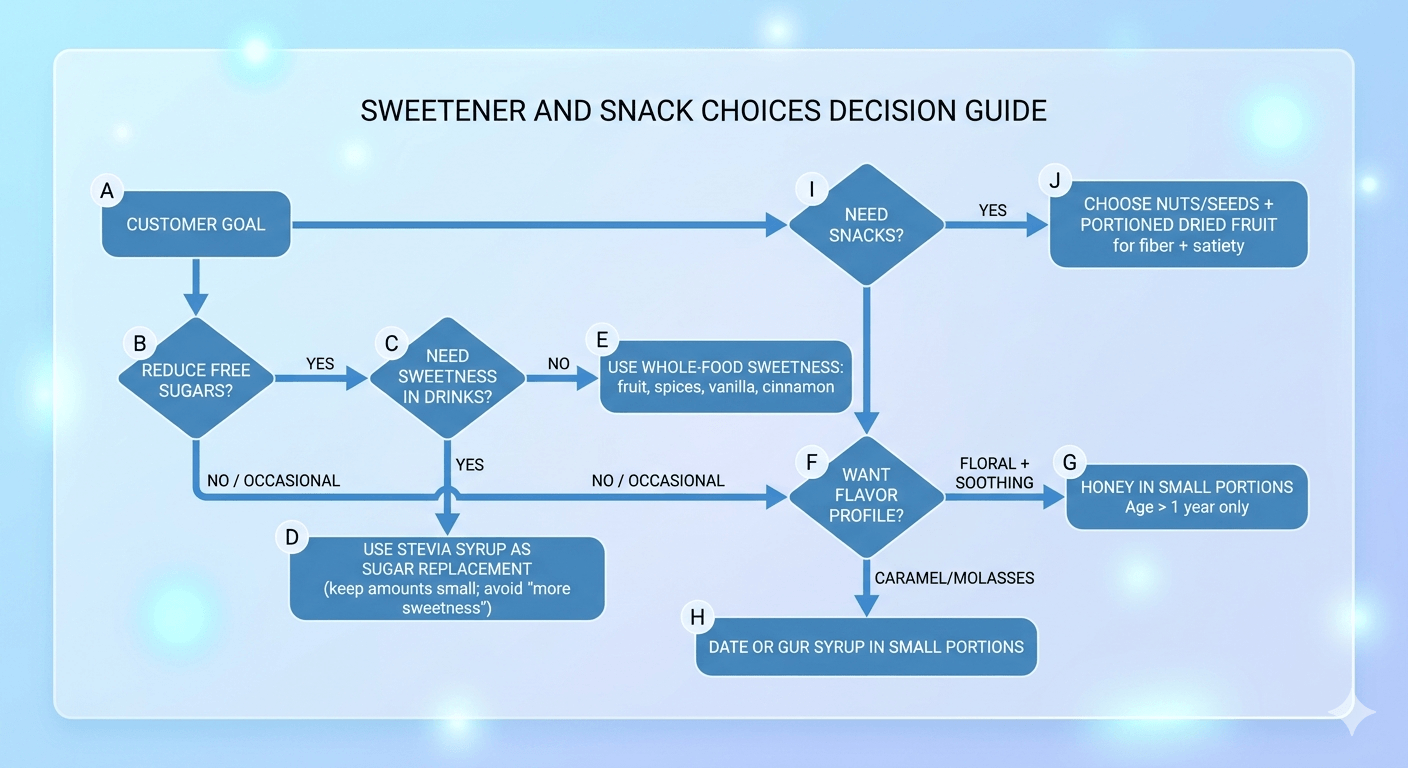
Decision flow for customers: choosing sweeteners vs whole-food options
WHO recommends reducing free sugars and clarifies that honey and syrups count as free sugars.
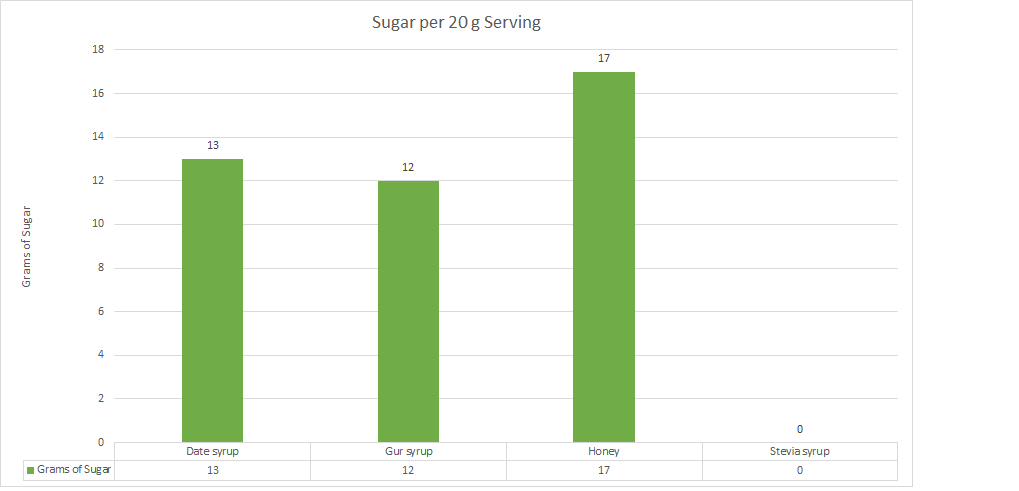
Bar chart: sugars per serving in Kohzar sweeteners (label-based)
Honey and syrups are free sugars by WHO definition; use portion control.
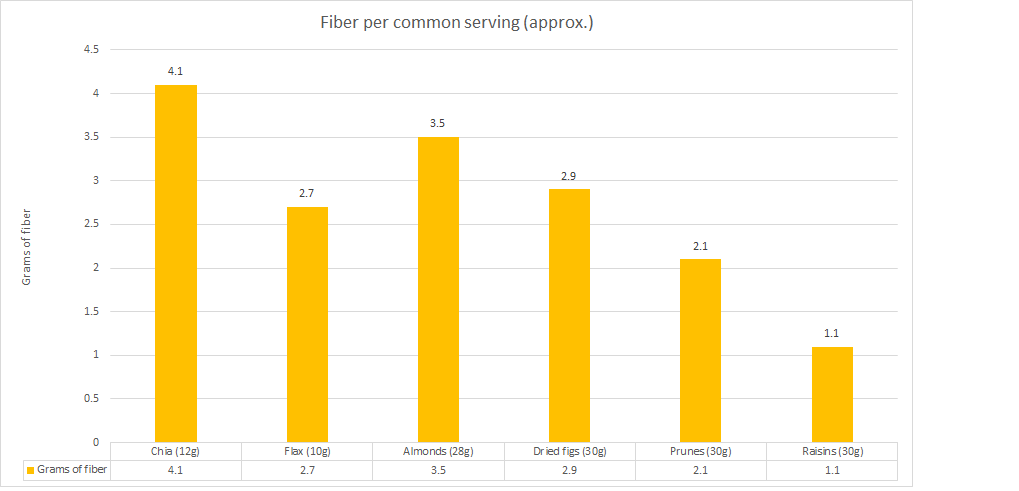
Bar chart: fiber per serving (why whole foods feel different than syrups)
Reference values from food composition data (USDA backbone).
Quality Standards
At Kohzar, quality is a system—not a slogan. We focus on careful sourcing,
hygienic handling, and consistent preparation practices to maintain taste,
freshness, and reliability across batches. As we grow, we are strengthening
our documentation, traceability, and quality checks to align with internationally
recognized food-safety and quality frameworks.
What we do
-
We prioritize clean ingredients and straightforward formulations.
-
We use hygienic handling and controlled processing steps designed
to protect product integrity.
-
We maintain batch-level tracking (where feasible) and continuously
improve our internal checks.
-
We are working toward expanding our quality systems to support
future third-party audits and certifications, as appropriate for each product line.
What we do not claim
We do not present our products as medicines. Our products are foods designed
to fit within a balanced diet and healthy lifestyle.
Customer safety
-
Peanuts, tree nuts, and sesame are major allergens; sesame is explicitly required
as a major allergen in U.S. labeling frameworks and is widely recognized in
allergen-labeling regimes.
-
Honey and syrups are free sugars under WHO definition; use portion guidance and
avoid describing sugar-based syrups as completely “diabetic-friendly.”