
Food labels are supposed to help people make better choices, but for many shoppers they do the opposite. There is too much information, too many health claims, and too many numbers without context. The good news is that you do not need to understand everything on the packet to shop more wisely. A good food-label […]
Food labels are supposed to help people make better choices, but for many shoppers they do the opposite. There is too much information, too many health claims, and too many numbers without context.
The good news is that you do not need to understand everything on the packet to shop more wisely.
A good food-label habit is not reading more. It is knowing what to look at first.
The FDA says the Nutrition Facts label can help you learn about, compare, and monitor the nutrients in foods, while NHS guidance says front-of-pack labels can help you spot foods that are high, medium, or low in fat, saturated fat, sugars, and salt.
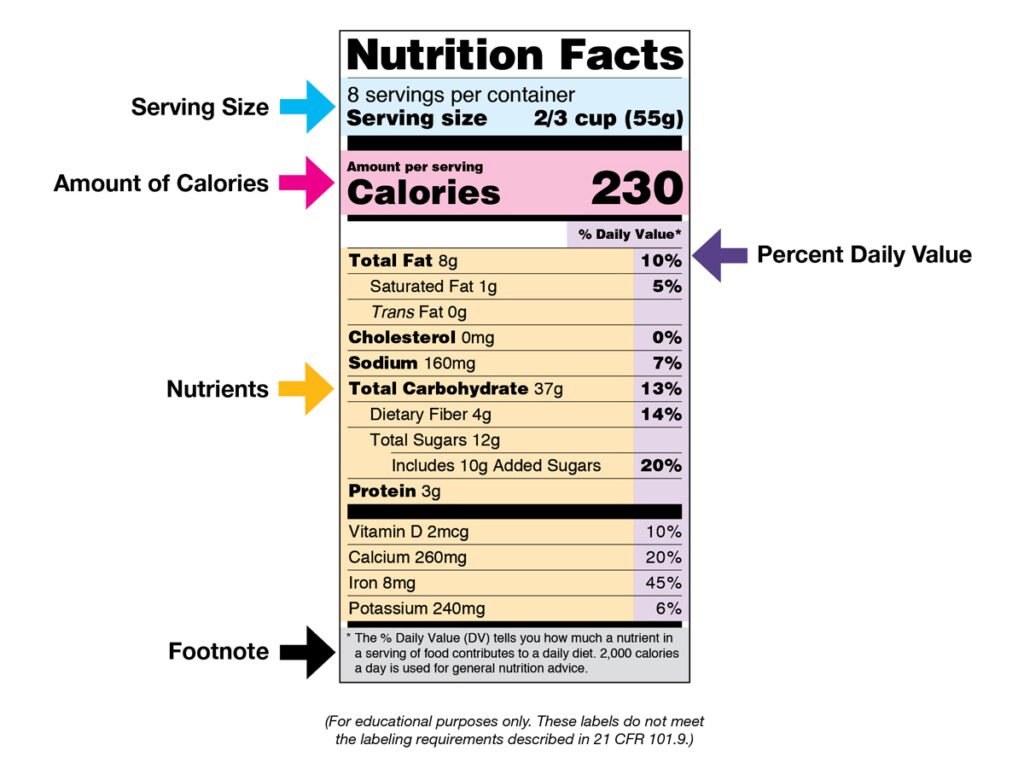
This is the first thing to check, because every number on the label depends on it.
The FDA explains that all the nutrient amounts shown on the label, including calories, refer to the serving size, and some packages contain more than one serving.
That means a packet may look reasonable until you realize:
If you eat double the serving size, you are also doubling:
Calories matter, but they do not tell the whole story.
The FDA says calories show how much energy is in one serving, and as a general guide, 100 calories per serving is moderate while 400 or more per serving is high for an individual packaged food.
But a food is not automatically healthy just because it is low in calories. A low-calorie product can still be:
So calories are useful, but they should be read alongside the rest of the label.
The % Daily Value tells you how much a nutrient in one serving contributes to your daily intake.
The FDA’s quick rule is:
That makes labels much easier to scan.
In general:
The label becomes much easier once you stop staring at every number and start using the 5% and 20% rule.
This is one of the most useful parts of the label.
The FDA now lists Added Sugars under Total Sugars, which helps show how much sugar has been added during processing. Harvard’s Nutrition Source also advises looking carefully for all sources of added sugar when reading labels.
This matters because a food may sound healthy but still contain a surprising amount of added sugar, especially:
A simple habit:
if two similar products are on the shelf, compare their added sugars first. Often that alone helps you choose better.
Salt is easy to overlook because the food may not even taste very salty.
The FDA recommends using the label to compare products, and NHS label guidance highlights salt as one of the key nutrients shown on front-of-pack systems.
This is especially useful when buying:
If one option is clearly lower in sodium and still fits your needs, that is often the smarter everyday choice.
If you want a packaged food to keep you full, fiber and protein matter a lot.
Harvard’s label guide is built around helping people understand what they are buying, and Harvard’s broader nutrition guidance consistently points people toward foods with better overall quality rather than just clever marketing.
A product with:
is usually more useful than one that is mostly refined starch and sweetness.
This is especially helpful when comparing:
The Nutrition Facts panel tells you the numbers. The ingredient list tells you what the food actually is.
Ingredients are listed in descending order by weight, so the first few ingredients matter the most. Harvard recommends reading labels and ingredient lists rather than depending too much on simplified front-of-pack rating systems.
A simple way to use the ingredient list:
The front of the pack sells the product. The ingredient list tells the truth.
NHS guidance explains that some products use traffic-light colors:
That is useful when you are shopping quickly.
But it is still smart to check the back label too, because:
Words like:
can sound impressive, but they do not automatically mean the product is a better overall choice.
Harvard’s food-label guide is specifically designed to help people navigate those kinds of package claims and understand what they are actually buying.
A “healthy-looking” package can still be:
That is why the label and ingredient list matter more than the slogan on the front.
If you want one simple system, use this order:
How much does the label actually refer to?
Useful, but not enough on their own.
These are often the biggest decision-makers.
Help you judge whether the food will actually satisfy you.
This tells you what the food really is.
That order makes shopping much less overwhelming.
Food labels are not there to make you eat perfectly. They are there to help you compare products and make smarter choices more often.
You do not need to read every package like a scientist. You just need a few reliable habits:
check the serving size, watch added sugars and sodium, look for fiber and protein, and do not let the front of the pack do all the talking.
If you want, next I can do “What Are Antioxidants and Why You Need Them” in the same Knowledge Hub style.